
If you manage security for a remote or hybrid team, you have almost certainly told someone, “don’t worry, it’s end-to-end encrypted.” It’s become a kind of security shorthand — a phrase that’s supposed to close the conversation. But end-to-end encryption is one of the most misunderstood terms in the entire security vocabulary, and that misunderstanding creates real risk.
Teams assume that because a tool advertises end-to-end encryption, everything happening inside it is automatically safe. That assumption is wrong often enough to matter.
End-to-end encryption is a precise technical guarantee, not a blanket promise of privacy or safety. It protects one specific thing extremely well — the content of a message or file while it moves from sender to recipient. It says almost nothing about everything that happens before, after, or around that message.
Understanding exactly where that boundary sits is the difference between using end-to-end encryption as one layer of a real security strategy and using it as a false sense of security that masks much bigger gaps.
This article breaks down what end-to-end encryption actually does, what it deliberately leaves exposed, how it compares to other forms of encryption your team already relies on, and what a realistic security posture looks like once you stop treating end-to-end encryption as a silver bullet.
What End-to-End Encryption Actually Means
End-to-end encryption, commonly abbreviated as E2EE, is a method of securing communication so that only the sender and the intended recipient can read the content. The message is encrypted on the sender’s device before it ever leaves, and it stays encrypted the entire time it travels across networks and through servers. It is only decrypted on the recipient’s device, using a key that the service provider never possesses.
That last part is the entire point of end-to-end encryption. In most encryption models, the company running the service can technically decrypt your data if it wants to, or if it’s compelled to. With true end-to-end encryption, the provider is architecturally locked out. Even if their servers are seized, subpoenaed, or breached, the content itself remains unreadable because the decryption keys were never stored there in the first place.
How the Encryption Keys Actually Work
End-to-end encryption relies on public-key cryptography. Each device generates a key pair: a public key that can be shared openly and a private key that never leaves the device. When you send a message, your app encrypts it using the recipient’s public key. Only the matching private key — sitting on the recipient’s device — can decrypt it.
Many modern implementations, like the Signal Protocol used by Signal, WhatsApp, and Google Messages’ RCS encryption, go further with a technique called forward secrecy. New session keys are generated for every message, so even if one key is compromised, past and future messages remain protected.
This is why end-to-end encryption is considered mathematically strong. Breaking well-implemented E2EE isn’t a matter of hacking a server — there’s nothing useful to steal there. An attacker would need to compromise one of the actual endpoints: your phone, your laptop, or the recipient’s device.
Where Encryption Happens on the Device
This is the detail that gets glossed over constantly, and it’s the key to understanding the rest of this article. End-to-end encryption protects data in transit and, in some implementations, at rest on the server. It does not protect the data before encryption happens or after decryption happens.
Before you hit send, the message exists in plaintext on your device. After the recipient opens it, it exists in plaintext on theirs. End-to-end encryption has nothing to say about what happens at either of those two moments — and that’s exactly where most real-world compromises occur.
What End-to-End Encryption Protects
Let’s be fair to the technology: end-to-end encryption solves a genuinely hard problem, and it solves it well. Here’s precisely what you get.
Protection From Network Eavesdroppers
Anyone intercepting traffic between your device and the recipient’s — on public Wi-Fi, through a compromised router, or via a man-in-the-middle attack — sees only unreadable ciphertext. This is the classic threat model end-to-end encryption was built for: someone sitting on the wire between two parties. For remote teams working from coffee shops, co-working spaces, and home networks of wildly varying quality, this alone is a meaningful defense.
Protection From the Service Provider
With proper end-to-end encryption, the messaging app, email provider, or file-sharing platform cannot read your content even if it wanted to. This matters for two reasons: it limits what a malicious or careless employee at that company could expose, and it limits what the company can be forced to hand over in response to a legal request, since it simply doesn’t have the plaintext to give.
Protection Against Server-Side Breaches
If an attacker breaches the server infrastructure of an end-to-end encrypted service, they walk away with encrypted blobs of data, not usable content. This is a substantial improvement over services where messages sit decrypted (or decryptable) on company servers. Several major breaches over the past decade have exposed enormous volumes of plaintext data precisely because the affected service didn’t use end-to-end encryption for storage.
Message Integrity and Authenticity
Most end-to-end encryption implementations also include integrity checks and authentication, meaning the recipient can verify a message actually came from who it claims to be from and wasn’t altered in transit. This protects against tampering, not just eavesdropping
What End-to-End Encryption Does NOT Protect
This is the section that matters most for anyone making real security decisions, because this is where organizations get burned.
Metadata Is Almost Never Encrypted
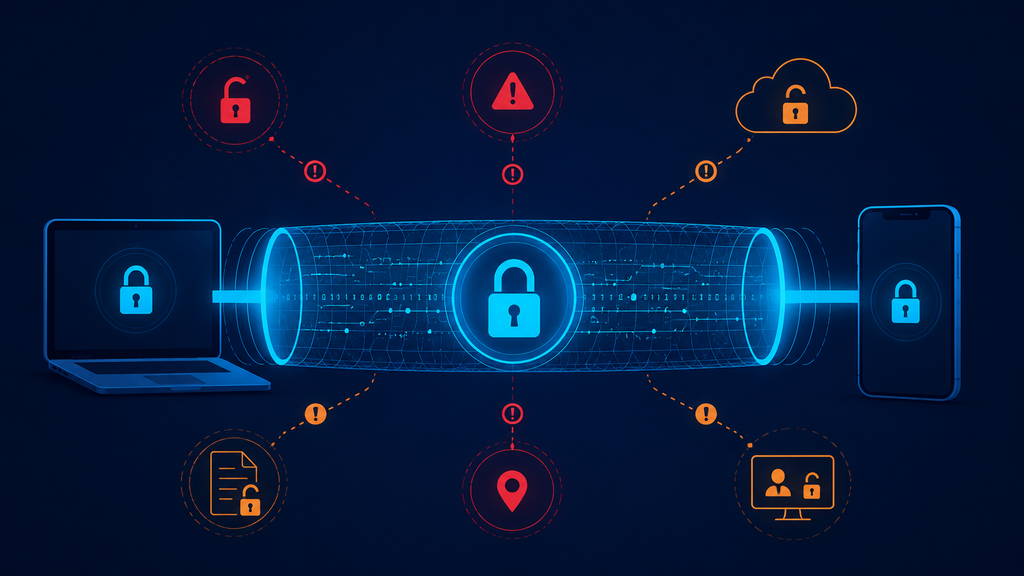
End-to-end encryption protects the content of your communication — not the fact that the communication happened. Who messaged whom, when, how often, for how long, from what location, and using what device: this metadata typically remains visible to the service provider and, in many cases, to anyone who can subpoena or breach that provider.
Metadata alone can reveal enormous amounts about relationships, behavior patterns, and even ongoing negotiations or incidents, even if nobody can read a single word of the actual conversation. The Electronic Frontier Foundation has documented how metadata analysis can be just as revealing as content — sometimes more so, because it’s structured and easy to analyze at scale.
Endpoint Compromise Defeats Everything
This is the single biggest blind spot in how people talk about end-to-end encryption. If an attacker compromises your device — through malware, a phishing-installed keylogger, a stolen and unlocked phone, or spyware — they can read your messages the same way you do: in plaintext, after decryption, directly on the screen.
End-to-end encryption protects the pipe between two devices; it does nothing to protect either end of that pipe. A team with excellent end-to-end encrypted messaging and unpatched laptops, weak device passcodes, or no endpoint detection is not actually secure — they’ve just secured the part of the chain that was already hardest to attack.
Backups Often Break the Guarantee
Many end-to-end encrypted apps let users back up their chat history to cloud storage for convenience. Historically, several popular platforms stored those backups without end-to-end encryption, meaning years of “protected” conversations sat readable on a cloud server the whole time. Some providers have since closed this gap with optional encrypted backups, but it is not universal, and it is frequently opt-in rather than default.
If your team enables cloud backups without checking whether those backups are also end-to-end encrypted, you may have quietly exported your entire message history outside the protection you thought you had.
Screens, Screenshots, and Human Behavior
End-to-end encryption cannot stop someone from taking a screenshot, forwarding a message to the wrong person, reading a screen over someone’s shoulder, or simply telling a third party what was said. This sounds obvious, but it’s worth stating plainly because organizations sometimes treat “we use an end-to-end encrypted tool” as a substitute for actual data-handling policy, rather than one layer within it.
The Recipient’s Device and Compromised Contacts
Encryption guarantees that only the intended recipient can read a message — it says nothing about whether that recipient is trustworthy, whether their device is compromised, or whether their account has been taken over by someone else entirely. If an attacker gains access to a legitimate recipient’s account, end-to-end encryption will faithfully and correctly decrypt every message for them, exactly as designed.
Group Chats, Bots, and Third-Party Integrations
Group conversations widen the attack surface considerably. Every additional participant is another endpoint where a compromise defeats the encryption for that thread. Bots, chat integrations, and connected apps often need to process message content to function — which frequently means the integration point itself sits outside the end-to-end encrypted boundary, even inside an otherwise E2EE platform.
Availability, Not Confidentiality
End-to-end encryption is a confidentiality control. It does nothing to guarantee that a message will actually arrive, that a service won’t go down, or that data won’t be deleted. Teams sometimes conflate “encrypted” with “resilient” or “backed up” — they are unrelated properties.
Legal Discovery and Organizational Policy
For regulated industries, end-to-end encryption can create genuine compliance friction. If your organization has legal obligations to retain and produce communications records, a tool that makes even you unable to recover message history from the server can conflict directly with those obligations.
Encryption that protects you from outside attackers can simultaneously complicate your own governance requirements — this is a real trade-off, not a hypothetical one.
Common Misconceptions About End-to-End Encryption
“End-to-end encrypted means anonymous.” It doesn’t. Your identity, account, phone number, or email is typically still tied to the conversation; encryption protects content, not identity.
“If an app says encrypted, it must be end-to-end encrypted.” Many services encrypt data in transit (TLS) and at rest on their servers, but the provider still holds the keys and can read the content. That’s encryption — just not end-to-end encryption. The label “encrypted” gets used loosely in marketing far more often than “end-to-end encrypted” is used accurately.
“End-to-end encryption means the company can’t see anything about you.” Even fully end-to-end encrypted platforms typically retain account information, metadata, usage patterns, and sometimes device information, none of which is covered by the encryption of message content.
“Once it’s end-to-end encrypted, it’s permanently secure.” Encryption strength depends on implementation quality, key management, and the security of the endpoints — which is why bodies like NIST publish and continuously update cryptographic standards rather than treating any algorithm as permanently settled. A theoretically strong protocol implemented poorly, or run on a compromised device, provides little real protection.
End-to-End Encryption vs. Other Encryption Types
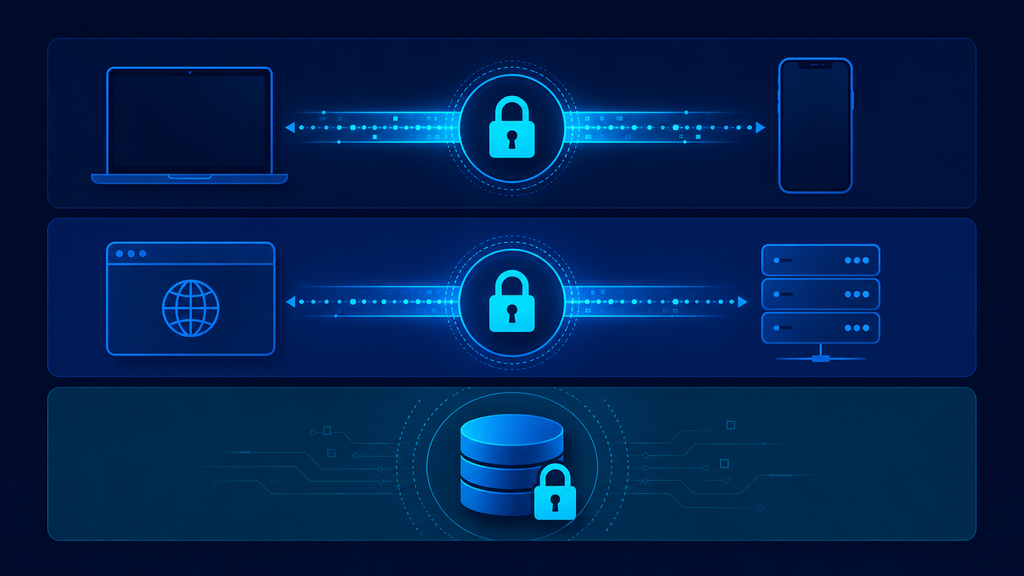
It helps to see end-to-end encryption next to the other encryption models your team relies on daily, because they solve different problems.
| Encryption Type | What It Protects | Who Holds the Keys | Typical Use Case |
|---|---|---|---|
| End-to-end encryption (E2EE) | Content between sender and recipient | Only the sender and recipient devices | Messaging apps, encrypted calls |
| Transport encryption (TLS/HTTPS) | Data while moving between your device and a server | The service provider (for its portion) | Websites, most web apps, email in transit |
| Encryption at rest | Data stored on a server or disk | The service provider | Cloud storage, databases, backups |
| Client-side / zero-knowledge encryption | Data before it’s uploaded anywhere | Only the user | Password managers, some file-sync tools |
Notice that TLS and at-rest encryption — which cover the vast majority of everyday business tools — both leave the provider holding the keys. That’s not necessarily a flaw; it’s a different threat model, one that trusts the provider not to misuse access rather than removing that access entirely. End-to-end encryption is the only model in this table where the provider is structurally excluded, which is precisely why it’s reserved for the most sensitive communication use cases rather than applied everywhere by default.
Practical Guidance: Using End-to-End Encryption Effectively
Knowing the limits of end-to-end encryption isn’t a reason to distrust it — it’s a reason to build the rest of your security posture around it properly.
Verify the Tool Actually Offers End-to-End Encryption by Default
Don’t rely on marketing copy. Check whether end-to-end encryption is the default for every conversation type the tool offers, or only available as an opt-in mode for select chats (a common pattern in video-conferencing platforms, where standard calls use server-side encryption and only “enhanced” or “advanced” modes are fully end-to-end encrypted).
Harden the Endpoints, Not Just the Pipe
Since end-to-end encryption can’t protect a compromised device, invest accordingly: enforce full-disk encryption, require strong device passcodes or biometrics, keep operating systems and apps patched, deploy endpoint detection tools, and require screen locks on a short timeout. This is where the real leverage sits.
Audit Backup Settings Explicitly
Check whether your team’s messaging tool backs up chat history to the cloud, and whether those backups preserve the end-to-end encryption guarantee or quietly strip it. Disable unencrypted backups where the option exists, or accept the trade-off deliberately and document it.
Separate What Belongs in E2EE Channels From What Doesn’t
Not every conversation needs end-to-end encryption, and not every sensitive conversation belongs in a channel that can’t be audited or recovered by your organization. Build clear guidance for staff: incident-related discussions, credentials, and sensitive personal data belong in end-to-end encrypted, access-controlled channels; anything subject to retention or compliance requirements needs a separate, governed process.
Train the Team on the Human Layer
Run through realistic scenarios — phishing attempts targeting device access, screen-sharing accidents during video calls, forwarding mistakes — since these are the failure modes end-to-end encryption was never designed to prevent. A short, recurring training cadence closes more real gaps than swapping communication tools ever will.
Treat Metadata as Sensitive Too
If metadata exposure is a genuine concern for your organization — for journalists, legal teams, or anyone handling whistleblower communication, for example — choose tools that specifically minimize metadata retention, not just tools that advertise end-to-end encryption for content.
Real-World Examples Worth Knowing
Signal is widely regarded as the reference implementation of modern end-to-end encryption, and its underlying Signal Protocol has been adopted, in whole or in part, by WhatsApp, Google Messages (for RCS chats), and Facebook Messenger’s optional secret conversations.
Apple’s own security documentation confirms iMessage uses end-to-end encryption between Apple devices by default, though messages sent to non-Apple devices fall back to unencrypted SMS. Zoom introduced optional end-to-end encryption for meetings, but it must be manually enabled and disables certain features like cloud recording and dial-in numbers, illustrating the real trade-offs organizations weigh when adopting it.
Email, by contrast, is end-to-end encrypted only when both parties actively set up something like PGP or S/MIME. Standard email, including most business email, is not end-to-end encrypted by default, no matter how secure the provider’s servers are.
FAQ: End-to-End Encryption
Is end-to-end encryption the same as “encrypted”? No. “Encrypted” is a broad term that can mean transport encryption, at-rest encryption, or end-to-end encryption. Only end-to-end encryption guarantees that the service provider itself cannot access the content.
Can a company be forced to break end-to-end encryption? A properly implemented end-to-end encrypted system means the company doesn’t hold the keys and genuinely cannot hand over readable content, even under legal compulsion. However, some jurisdictions have proposed or passed laws requiring backdoors or client-side scanning, which would undermine the guarantee at the endpoint rather than the server — a distinct and ongoing policy debate.
Does end-to-end encryption protect against phishing? No. Phishing targets the human and the endpoint, not the communication channel. End-to-end encryption can even make some phishing attempts feel more trustworthy to a target, since users associate encrypted apps with safety.
If my messaging app uses end-to-end encryption, is my backup also protected? Not automatically. Check your app’s specific backup settings — many platforms offer encrypted backups only as an opt-in feature.
Does group chat encryption work the same way as one-on-one chats? Group chats can still be end-to-end encrypted, but every added participant is an additional endpoint, meaning the effective attack surface grows with the size of the group.
Is video calling ever truly end-to-end encrypted? Some platforms offer it, but often as an optional mode that disables server-side features like recording, live transcription, or dial-in access, since those features require the server to process the raw audio or video.
Read Also
- The Psychology Behind Scam Calls: Why Smart People Fall For Them
- Home Router Security: The Default Settings Putting You at Risk
- Ransomware Warning Signs: How to Catch an Attack Before It Spreads
- How to Tell If Your Phone Has Been Hacked: Key Warning Signs
- Zero-Knowledge Encryption: What It Actually Means for Your Passwords
Conclusion
End-to-end encryption is one of the strongest tools available for protecting the confidentiality of communication — and it deserves the reputation it has for that specific job. But it was never designed to be a complete security model on its own, and treating it like one is exactly how organizations end up exposed despite feeling protected.
The pipe between two devices can be mathematically unbreakable while the devices on either end remain wide open, the metadata keeps flowing, and an unencrypted backup sits quietly in the cloud. Real security means knowing precisely where end-to-end encryption’s guarantee starts, where it stops, and what has to fill the gap on either side.
Build your policies around that boundary, not around the marketing promise, and end-to-end encryption becomes what it should be: one strong, well-understood layer in a much larger defense.